Rise up this mornin', smiled at the risin' sun,
three little birds pitch by my doorstep,
singin' sweet songs of melodies pure and true,

sayin' "This is my message to you-ou-ou-ou-"
~Bob Marley

Saturday, February 9, 2013

Growing Leaders


A Growing Leader!

When Mark harvests his corn, he saves some of the seed for planting, ensuring another crop to harvest. Our corn continues to produce, our chickens continue to eat corn and we continue to receive eggs. It’s a sustainable system.

So when I began to plan for an environmental summer camp for the children in our barrio, I had to stop and ask myself the question, “Is this a sustainable system? Will this project continue to happen even after Mark and I return to the States?” My answer to myself was, “Probably not….”

Putting my enthusiasm for making leaf prints aside, and the markers back on the shelf, I noticed my fifteen- year-old neighbor walking towards my house. Then it hit me- if they had an interest, the bright, energetic teenagers in the barrio could learn and lead a camp for their younger neighbors.

 It was time to “grow” some leaders!

Celsa was interested and recruited two friends to help plan, prepare and present an Environmental Summer Camp for the kids in Barrio San Miguel.

We started with brainstorming ideas and charting them. They decided on a 3-day camp, 3 hours per day. We charted daily schedules; listed resources needed, and divided the responsibilities.
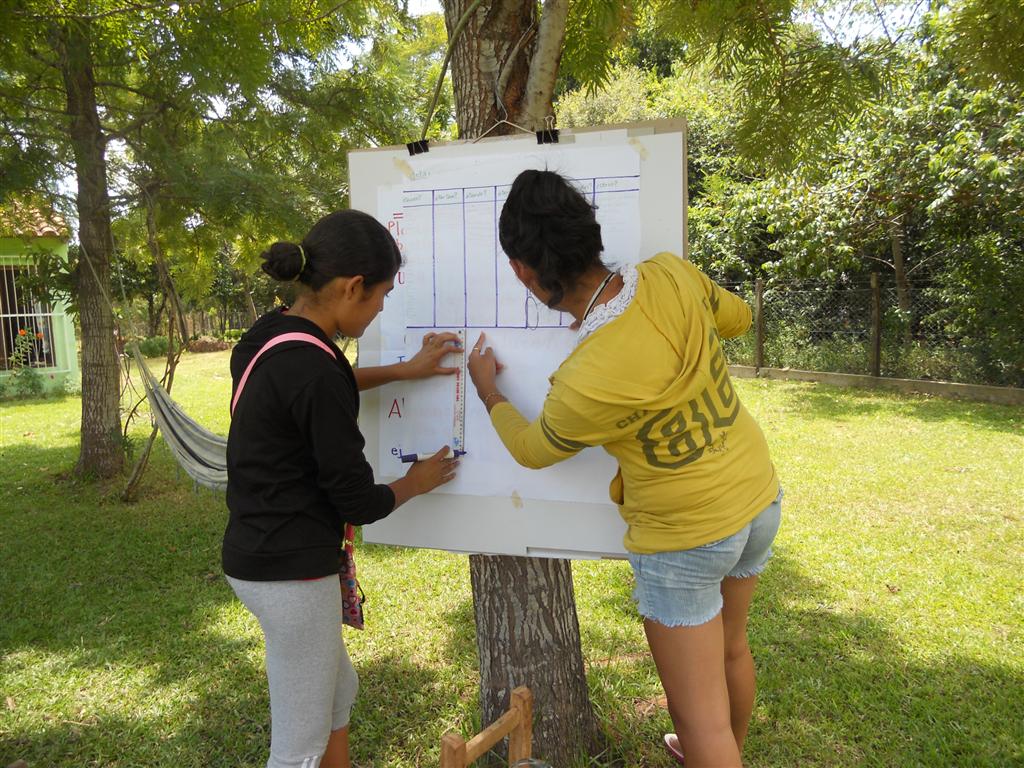
Brainstorming, Organizing and Scheduling
 The girls did research on the themes they selected, (Managing Trash; Native Trees; Birds and Animals of Paraguay), created posters and practiced their presentations. They prepared art projects that went with each theme, (Yeay- they selected leaf prints!), and planned fun recreational activities.
Preparing Materials and Presentations
After 5, half-day planning/ work sessions, followed by walking the barrio to personally invite children to attend the camp, the girls were ready!

The teenagers did a great job “leading” their 18 participants during a fun, informative, and engaging 3 day Environmental Summer Camp! They worked together, followed their plan, and shared responsibilities that reflected their strengths.
"Tree Day" Discussion

Mark Shares Information on Planting Tree Seeds

Were there a few bumps in the road? Sure there were- That’s when I bit my tongue, and they learned from the process! We saved all of the planning charts, schedules and teaching posters to serve as guides in planning future “camps,” in hopes that it becomes a sustainable practice.

The end result? Happy camp participants, new learning about important environmental themes, proud camp leaders, and a new crop of enthusiastic, growing leaders!
"Campers" Showing Off Their Certificates


Saturday, February 2, 2013

Who is the Tooth Fairy?


When our neighbors, Lorenzo and Jenny came over for a visit, we had an interesting conversation.

Lorenzo had lost a tooth, giving him that cute six-year old jack-o-lantern smile. After hearing the story about his aunt’s technique of painlessly extracting his loose tooth, I asked the obvious question, “Did you put it under your pillow?”

Jenny and Lorenzo looked at each other with confused expressions on their faces. Why on earth would someone put a tooth under a pillow? After asking twice, I realized the confusion was not stemming from misunderstanding my words, (which STILL happens), but from not being familiar to the whole notion of the Tooth Fairy….

So, I asked, “When a tooth falls out, what do kids in Paraguay do with the tooth?”

The answer to them was as obvious as the Tooth Fairy regime was to me- “Obviously you throw the tooth onto the roof of your house! Why would you put a tooth under your pillow? How would Kyju’i find it there?”

That led to my explanation of the story of the Tooth Fairy, (a really bizarre notion when you think about it…). Jenny then shared the story of Kyju’i. It went something like this…

In Paraguay, when a child looses a tooth, she must throw it on top of the roof of her house, and recite,
 “Kyju’i, Kyju’i, eme’e cheve che raira ipyahuva.” Translating from Guarani to English- “Kyju’i, Kyju’i, give me a new tooth.”

During the night, Kyju’i, a cricket, will visit and collect the tooth from the roof. If he is successful in finding the tooth, Kyju’i will keep it, and in return will ensure that another tooth grows in its place. And sure enough, those “new teeth” seem to grow in every time!

So there you go, no monetary trade off, just an exchange for a bigger, better model. Interesting these cultural traditions we have for children. Too bad the magic doesn’t continue for adults. Then again, I’d be happy to keep all of my teeth at this point!

Thursday, January 31, 2013

La Princesa Sofia


Hello everyone! This is a guest blog entry written by my sixteen year old neighbor, Naty. She did a great job writing about her new baby niece and we decided she should become a published author!

Me volví tía a los 16 años de edad y soy una tía muy feliz como no serlo si mi sobrina es una bebe hermosa ella nació el 19 de enero del 2013 a las dos de la tarde se llama Sofía Silva ese día en mi vida por primera vez comprendí lo que significa Ciclo de Vida porque apenas la mañana del 19 de enero era una mañana triste para mí porque perdí a un amigo muy querido por todos en un trágico accidente a Víctor Sebastián Ortiz Zorrilla y apenas empezaba la tarde sonreí porque llego a mí la noticia de que mi sobrina había nacido comprendí que el Ciclo de Vida es cuando acaba una vida y empieza otra vida Sofía lleno todo el vacío que había dejado en mi la perdida de aquel amigo que nunca olvidare sus abuelos Félix y Julia y su querida mama Fátima están felices y como no mencionar a sus tíos Joel y Perla Dios es generoso y quiere que todos sus hijos estén felices y a nosotros nos dio un angelito con brillo de paz que reboza con su sonrisa amor en nuestros corazones en esta casa humilde creciste lloraste por primera vez y en esta casa oirás historias de tu más tierna infancia cada momento cada cosa aunque parezca insignificante es algo maravilloso para nosotros hay estas doncella durmiendo entre rasos y sonando cosas maravillosas en príncipes en hadas o en unicornios quizás Sofía mi Ángel mi princesa el amor de nuestras vidas...nunca te alejes de nosotros porque eres nuestro sol y cuando el sol entra llega la noche y nuestras vidas sin tu presencia sería una vida oscura sin iluminación eres una pequeña luciérnaga en nuestras vidas con tu luz no habrá oscuridad que nos haga tropezar en la inmensidad porque eres y serás siempre nuestra lucecita de Amor!!!


Sunday, January 20, 2013

Holiday Traditions


As you can imagine there are many differences when it comes to celebrating the holidays in Paraguay, but there are many similarities as well! Here are a few examples that come to mind….
Food- lots of Food! At the top of the menu- carne asada, or bar-b-qued beef and pork. Clarico, or finely chopped fruit placed in a 5-gallon bucket retrieved from the barnyard, which is then filled with wine, champagne and orange soda. Finally, the tatakuaa, or earthen oven, is fired up and readied for the chipa guazu. Chipa guazu, (sounds like something from a Dr. Seuss book, doesn’t it?), is a special bread made from freshly ground corn, eggs, oil, and lots of homemade cheese- delicious! Paraguayans actually plant their corn so the harvest coincides with the holiday season in order to prepare this specialty.

Cutting fruit for Clarico
Visiting neighbors with Holiday Greetings. It is a tradition with my family, in the states, to bake Christmas cookies, then share with friends and neighbors. I decided to continue this tradition in Paraguay, and some neighbor kids joined me in baking.

 Because I didn’t have plates, we cut plastic soda bottles and placed our goodies inside. After tying tiny homemade cards to the bottles, we were off to visit and wish our friends and neighbors a Feliz Navidad!
 
At many homes large outdoor crèches were assembled complete with all the key players, decorated with greenery and flowers from the yard, candles and offerings of fruit and candies.
 
On Christmas Day, gifts are not exchanged. Instead, Dia de Los Tres Magos,(Day of the The Three Wise Men), is celebrated on January 6th.  On this day all good children place a shoe near an open window in the evening, hoping it will be filled with treats and small toys. As you can see, Los Tres Magos have an interesting sense of humor, as this is what Mark found in his shoe!
 
Here’s to hoping you had a wonderful holiday season, whether in the States or in Paraguay celebrating both old and new traditions!

Saturday, December 29, 2012

The Best Christmas Gift Ever…..


Was a Visit From our Kids!
Our beautiful kids, (minus 1- we missed you, Eliot!)

In late November our kids journeyed all the way to Paraguay to visit us and see some of the sights in South America. It was amazing to see them, listen to stories about their lives, get lots of big hugs, and see that that these wonderful people who we get to call family are doing well and doing good in the world!

Our travels and adventures went something like this…..

After resting and visiting Mercado 4,
Ty at Mercado 4 where he got his guampa, bombilla and possibly his awful stomach bug!
the Peace Corps office, markets, plazas, and other sites in Asuncion for a couple of days, we got a rental car and headed for our community.  During the 4 days in Arazape, our kids got to see our work in site, meet neighbors, experience the culture, and help open a new library in a small barrio school.
Amber and Ashley help pass out books for the new library in Jhugua, Paraguay.
The kids bought guampas, bombillas, and hammocks to take a little piece of Paraguay home with them!

We celebrated Christmas a month early, ate a big pot of beans, and traded gifts of handmade items from Paraguay for jars of peanut butter, spices, Sierra Nevada pale ale, and recorded music from home! Oh, and did I mention that I got to feel my first grandbaby, due in April, kick for the first time?!

Dave’s awesome driving skills took us to Encarnacion, the Jesuit Ruins of Trinidad, then North to Ciudad de Este. We crossed the Rio Parana on a ferry to Argentina, and arrived at the “tres fronteras” of Paraguay, Brasil, and Argentina. Despite a little rain, Iguazu Falls was incredible, especially la Garganta del Diablo, the rain forest, the animals, birds and butterflies! After 3 days in Puerto Iguazu, we returned to Asuncion.

The "crew" in front of the "Garganta del Diablo", Iguazu Falls, Argentina
Unfortunately this was the end of our visit with Ashley and Tyler, who had to return home. There were lots of tears- so hard to see them go… They boarded a plane, and we, (Amber, Dave, Mark, and I), hopped on a bus to Argentina. We traveled through Resistencia, and Salta, finally ending up in San Pedro de Atacama, Chile. We took a two-day tour through the Atacama Desert, (the driest desert in the world), and the Salar de Uyuni, Bolivia, (the largest salt flat in the world)- breathtaking with red lakes, pink flamingos, and volcanos reaching 19,000ft- like being on another planet! We even stayed in a hotel constructed of salt, with rock salt floors!

Amber and Dave at the Salar de Uyuni, Bolivia
A night bus brought us to La Paz, Bolivia with busy street markets, colorful textiles, and women wearing bowler hats! Onward to Cuzco, Peru where we prepared for another big adventure- a four day trek to Machu Picchu. The trek was daunting at times, (where is the oxygen at 12,000ft?), and gave us a true appreciation for the Inca who used this trail for travel.
Mark and I dumped our backpacks to take a break on the Inca Trail to Machu Picchu in Peru.

We were rewarded with once in a life time scenery and glimpses of the past, especially as we rounded the corner to see Machu Picchu at sunrise, in all of its glory!

We made it! Our trek group posing in front of Machu Picchu.
The next morning, Amber and Dave hopped a flight back to the states, (more tears), and Mark and I boarded a bus to Copacabana, Bolivia. We stayed in hotel on the shore of Lake Titicaca, (highest navegable lake in the world), enjoyed this beautiful place and rested our weary bones.

 Women near booths selling decorations for "the blessing of the cars" in Copacabana, Bolivia
We next headed to Santa Cruz, Bolivia, where we boarded another bus and finished the last leg of our journey back to Asuncion.

In all- Five countries, fascinating destinations, interesting cultures, beautiful scenery, awe-inspiring adventures, and incredible opportunities- my favorite part, you ask?

The best Christmas gift, ever…. Spending precious time with our fascinating, interesting, beautiful, inspiring, incredible kids, (minus one- we missed you, Eliot!)!

Thursday, November 1, 2012

Books for Kids!

Mark watches as the kids check out their new books!

It’s hard to imagine a school without books for kids, yet I read this was the case before our departure to Paraguay. I decided this was one way we could make a difference for the community in which we served. So, before we left the states we began the process, continued our work with the people in our community, and finally, last week, at an assembly, we presented one of our schools with a new library display case full of books! 
Susana, "Look at this!"
The kids were really excited, the teachers thankful, and we were happy to see the wonderful results of this collaborative process! With the desire to have as many minds and hands on this project as possible, the process went something like this:

  1. Before leaving the states, I found a source of books in Spanish, from discontinued programs, that were headed for the recycler, and received gifts of books to contribute to this project.
  2. For Christmas, our parents gifted each of us with an extra baggage fee, so we could each bring 50 pounds of books with us to Paraguay.
  3. When our friends, Mary Jo and Charlie came to visit us, they each brought an additional 50 pounds of books for the project.
  4. We started reading with kids during our Club de Libros every Saturday- these kids could not get enough of reading and listening to books! Though this was a successful project, we were concerned about its sustainability after we returned to the states, and knew we had to take it to an institutional level, sooo….
  5. We talked with teachers and the principals at both schools to get input on the project. We also talked about training and how the books might be utilized in the classrooms and with individual students, including: a system for check out and borrowing; care of books; and strategies for read alouds, silent reading, and developing strategies for building comprehension.
  6. We met with the Comision de Padres about funding a display case for the books, after creating a design and consulting with a local carpenter. They decided to fund the project!
  7. Next, we worked with the carpenter on the final touches on the design of the project. After two meetings and lots of sketches, we all met at the school for final approval of the design and price.
  8. The carpenter finished the project- it turned out exactly as we had hoped!
  9. Our next task was to get the case to the school… the local police station had a pickup, so we asked them to transport the display case from the carpenter’s house to the school. Mark and I held on to the case in the back of the police truck as they headed down the bumpy road to the school!
  10. We then worked with students at the school to apply varnish to the bookcase. They were curious about what we were doing and very eager to help!
    Kids adding the finishing touches to the new book display!
  11. The following week we brought 250 books to the school, and with the help of the kids, stocked the new display. When the Comision de Padres save enough for an additional book display, the remaining 250 books will be taken to the school.
  12. Finally, during a school assembly, we presented the completed project to the school with thanks to all involved! And thanks to all of you for your help, offers to help and good thoughts along the way!
    Presenting the new books at a school assembly, along with a few rules for taking care of books!
Finally, after over a year in the works, the teachers and students in Arazape have books! Books for: teaching tools, reading for pleasure, reading aloud, learning about new ideas and places, and just having time to hold a book in their hands and dream…..

Saturday, October 6, 2012

Clases de Ingles


Teaching English language classes was not part of our plan when we considered project goals for our service. So, when a woman inquired about English classes for her daughter, I asked her to send her daughter to speak to me, thinking that would be the end of it.

It wasn’t long before Zoila approached us, asking for help. She explained that she was enrolled in an English class at the colegio. The problem was, however, that her teacher didn’t actually know how to speak English. Instruction consisted of copying sentences in English from the blackboard, silently. Zoila knew she needed to hear the language and actually practice speaking to learn English.
Practicing English and making Bean Burgers
So… that is how our Conversational English class began, from our house, 6 hours per week, 4 committed students. We talk a lot, study new vocabulary by theme, use sentence frames to prompt conversation, and focus on forms and functions. This energetic group of 16-18 year-olds don’t hesitate to laugh at each other and themselves, as they practice aloud and improve with each session. They decided to commit to 100 hours of instruction/practice, after which, we will be authorized to provide them official certificates issued by the SNPP, (Servicio Nacional de Promocion Professional), under the Paraguayan Ministry of Justice and Work.
Other Projects- making glass planters and earrings, while practicing English

It wasn’t long before younger siblings and other kids took note of the English classes. Now Mark also teaches a class for younger kids. They have so much fun learning and “acting out the words”, no one wants the class to end!
Mark's English Class

We know this project is not sustainable. When we leave Arazape, the classes will end. But being the only English speakers in our town, how could we refuse to help these kids? And who knows? Helping them gain some English skills may even give them a leg up on preparing for the university or getting a better job.


Wednesday, September 12, 2012

Talkin’ Trash


Few communities in Paraguay have garbage collection service and Arazape is no exception. Here trash is either buried, burned, or just left in piles. Community members identified trash in the streets as a concern, according to the survey we conducted when we moved to Arazape. A seventh grade teacher asked me to help her teach lessons to raise awareness about trash and to help educate students about recycling and re-purposing. It has been a lot of fun working with these kids and helping them to connect with the needs of their community.
Decomposition time lines in groups
Topics we have covered so far have included: separating inorganics from organics and creating compost; separating inorganics and recovering recyclable materials; creating a decomposition timeline; and creative uses for re-purposed items.
How long does that take to decompose?!
Each lesson has been followed by a project where we re-purpose trash to create a useful item. So far, students have created: wallets from milk cartons; bracelets from plastic bags; baskets from plastic soda bottles, and planters from cutting glass bottles.
Baskets from plastic bottles
All of these items will be on display at the end of the school-year celebration, which will raise the awareness of other students and community members, as well. Next step will be to work with the school to start a recycling pilot program, with kids taking the lead in teaching other kids and talking to the intendente of the municipalidad about a way to transport the materials to the recycling collection facility, which is an hour away.

Mark holding the bottle as a student cuts it with wire and friction
The finished product- Que lindo!

If the recycling project works within the school, our next step will be to branch out into the community. Ideally, we will be working with the teacher to support kids as they take this on as a class project within their community.
Making adjustable bracelets from plastic bags
So, this is this kind of trash talk that’s been going on here in our community. Hopefully the stars align and the project comes to fruition- development work takes a lot of time and finger crossing!
My English class students show off their glass cutting skills!

Thursday, August 23, 2012

Ch-ch-ch-changes


Blancita's family planting their new tree
 After 8 months in site, I thought it was a good time to reflect on some of the changes we've experienced since we first arrived. Here are a few that come to mind....
* When we do our laundry, our neighbors no longer stare when they see Mark doing, “women’s work.” Also, I don’t get scabs on my knuckles from scrubbing anymore! 
From the wash buckets to the barbed wire fence to dry
* I am no longer afraid of getting shocked by our shower head. Our hot water is heated at the source, and electrical wires run right into the shower head. Mark has said that he touched it and didn’t get shocked. I’m content to keep my hands far away from the place where water and electricity mix!  
Would YOU touch this thing???
* Though far from being fluent, my language skills are improving, gone are the days of memorizing a phrase at a time, and trying to create a dialogue in my head before approaching someone. I even find myself “getting” the jokes and telling a few of my own. Though, I do have to admit, in the English class that I’m teaching I had my students roaring with laughter. Instead of saying that in the Fall, the leaves, (hojas), fell from the trees, I said eyes, (ojos), fell from the trees. Oops! 

 * I no longer reach for the flusher, only to find it’s not there. I instead grab the string and pull. And, not to get too graphic, but the toilet paper now always makes it’s way into the wastebasket instead of mistakenly dropped in the toilet.

 * We built a “lombricera” for our worms, so they have moved from a fruit crate in our kitchen to a more spacious brick house, outside. Many Paraguayans are terrified of the worms, but are really curious about our great veggies yields. Worm castings make amazing fertilizer!
My first masonry project- lombricera made of bricks and mud

* I never thought I’d see the day, but I can now officially say I like mondongo, (cow stomach), and batibarillo, (random chopped internal organs in a rich brown gravy). I prefer my cow stomach coated and fried in pig grease, (milanesa).
* We no longer dread trying to maneuver the public transit system in Asuncion. When we first used the buses in Asuncion, we once ended up at the dump, another time at the end of the bus line, in the middle of nowhere!  We now know the collectivo numbers that can get us to most parts of the city.
Mark's prized cauliflower
* We now spend more time eating and sharing vegetables from our garden, than we do working in our garden. Our neighbor always seems to return the favor by turning the fresh veggies into something fried called a tortilla, (a mixture of flour, egg, salt, cheese, and vegetables, dropped by the spoonful into hot oil to fry until crispy). I think it is our way of meeting in the middle- they’ll eat the veggies if we prepare them their way. I reciprocate by eating the tortillas, which, I have to admit, are delicious!  
Fresh veggies from our garden that escaped the tortilla!

* Many of the people who I used to say hello to in the streets and then walk quickly by, have become friends. I find myself going out to run an errand, only to stop and drink terrere with someone and catch up on the latest, or discuss the possibility of a garden, planting trees, or the best time to plant mandioca, (during the new moon of course!).  
Ramona's whole family pose with their newly planted tree

  * We're in the planning stages, working with the school Principals and   Comisiones de Padres to open school libraries, and get books in the hands of kids! Right now we're working on getting funding to buy book displays, developing a plan for how the books will be used in the school, training for staff and students... one step at a time.
One of our planning charts

  *  I used to consider this experience as an avenue to give and share of myself. I have discovered the many gifts, I instead, have received from Paraguayans- unhurried time and patience as I try to find the correct words to convey what I am trying to say; food from their kokues, though there may not be much to share; continued informal lessons in Guarani, they just won’t give up on me!; a third generation artesania sharing her art of crochet, we all laughed together as my fingers fumbled through the process, but in the end I was able to produce a hat!; the warm and welcoming feeling we have received by this wonderful community which may look poor, but is so rich in the gifts the people so freely share.
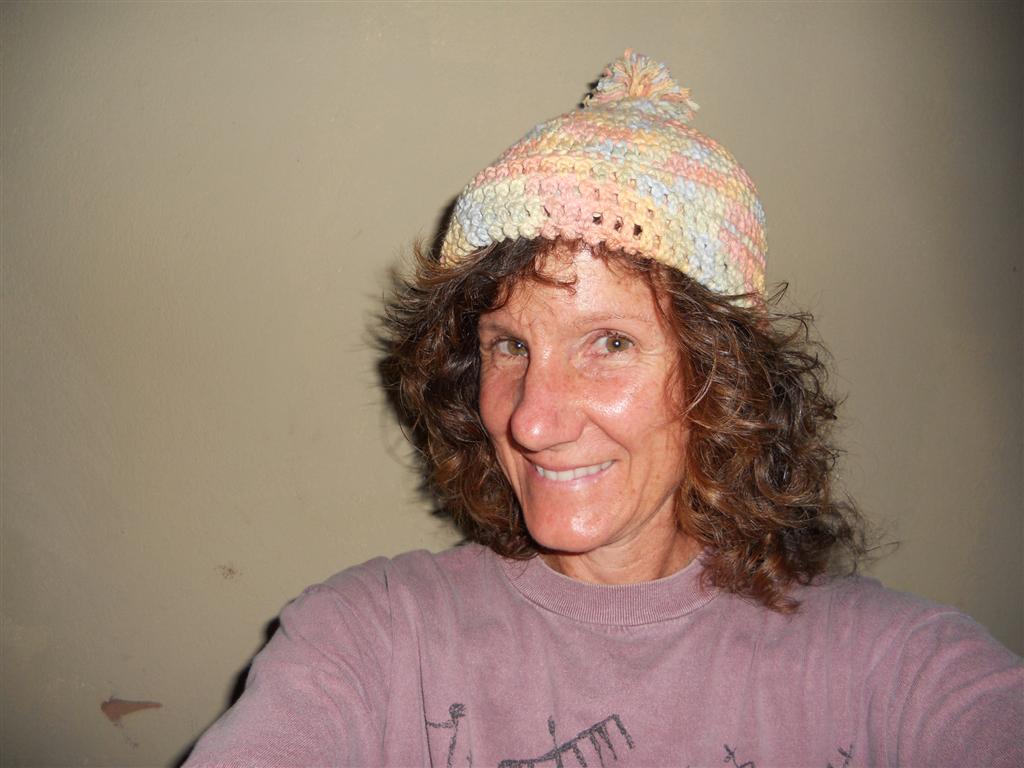
My Handmade Crocheted Hat- Thanks Lidia!

Sunday, August 12, 2012

Dia de Arbol- Yes, It’s Another Celebration!


Dia de Arbol!
My most recent blog posts have been about parties, festivals and celebrations. So, what about the work you may be wondering, you know, the actual volunteerism part of the adventure?
Well first of all, our main task as Peace Corps Volunteers is about development. It would be so much easier to build a structure, dig a well, or buy something needed and give it to the people. Development work takes time- it takes developing language skills, building relationships, learning about the culture, listening to Paraguayans and talking to them about what they want for their community. Then, development work is about finding members in the community who are interested in developing a plan, and helping them to lead the charge, or at least be active participants.
One event that I feel encompassed many of the elements listed above was our recent "Dia de Arbol", (Day of the Tree), celebration, which took place at two different schools, involving about 190 people. From a development perspective:
  1. We conducted a Community Survey, (in Guarani), and  discovered that planting more trees in the community was a high priority item for the people in Arazape.
  2. I surveyed the teachers in the school, (Pre escolar- sixth grade). Nearly all of them  indicated they were interested in a "Dia de Arbol" celebration.
  3. Together with teachers, community members, and other volunteers, we created a program that would involve every class in the school.
    Third Graders "Ham it Up" for a Picture
  4. Together, the teachers and I, worked to practice with each class four times prior to the event. During this time I modeled alternate instructional methods, and was able to see teachers try some of these techniques as well!
    Second Graders Perform Their Chant
  5. Next, after all the arrangements, preparations, and practice, the event was cancelled! When it rains or even looks like it will rain, school is cancelled. This is where I developed more patience….
  6. A date was rescheduled for the celebration. I talked with 5 students from the colegio, (high school), about volunteering to help with the event.
  7. Finally the big day arrived! The most exciting part about this project was that kids were teaching other kids about trees: Pre-escolar and first grades teamed up to sing the parts of the tree in Guarani, complete with hand/body motions; Second grade performed a chant about caring for trees, including visuals; Third grade taught their peers about valuing trees and the many gifts they provide; Fourth grade shared information about resources provided by trees and created a tree using props; Fifth grade demonstrated the process for correctly planting a tree; and Sixth graders each illustrated a page from Shel Silverstein’s book, The Giving Tree, (El Arbol Generoso, in Spanish), and read the story to the audience.
    Kids teaching Kids!
  8. Next, every class, using their newly acquired skills, planted a tree at the school. These were trees grown from seeds collected in the community and started by kids in our neighborhood six months in advance!
    Mark Helps Pre-schoolers Plant Their Tree
  9. Finally, volunteers led tree related activities in the school patio, for the kids to enjoy: leaf prints in homemade play dough; leaf sorting and categorizing; drawing and coloring your favorite tree; and pin, (well, tape), the leaf on the tree while blindfolded, (and really dizzy).
    Volunteers Lead "Pin the Leaf on the Tree"
The result? From the perspective of new learning, proud kids and parents, lots of fun, and most importantly, development on many levels- SUCCESS! So, as you can see, I have found a way to celebrate while I work- now that sounds Paraguayan!