Rise up this mornin', smiled at the risin' sun,
three little birds pitch by my doorstep,
singin' sweet songs of melodies pure and true,

sayin' "This is my message to you-ou-ou-ou-"
~Bob Marley

Sunday, January 8, 2012

Well, Okay...


During our pre-service Peace Corps interview, I said I could do it, so I did. While our host prepared to walk to the kokue to harvest mandioca, Mark and I, too, got ready to go along. At this time, I was told by our hostess that I was to stay at the house with her. When I persisted, her husband said it would be better for me to work at the house, that it would be too hot for me, (a woman), in the fields. So, I did it- respected cultural norms and remained at the house to do, “women’s work,” for a little while, anyway…..

Did I mention that I pouted for a short time? Well, I did, but not for too long. I decided to get over it and get out into my community. I met a woman spinning wool and commenced with my community needs assessment questions. Her responses were entirely in Guarani, (most people speak a little Spanish, too), and to my surprise, I was able to understand enough to get some responses down!

As I continued down the dirt road to a neighboring community, I encountered a plantita and seed source gold mine! Paraiso Gigante, Yvyra’ro, Karuparu Kuru, and Yvyra Pyta, just the trees I had been looking for, as we decided to reserve a small part of our garden for a tree nursery as part of a reforestation project.

Further down the road, I heard the high-pitched hum of, “the bichos that come with the watermelons.” I was finally able to view one up close: a thick, greenish, 2 ½ inch fly-like insect with large lacey wings. I don’t know much else about them, other than there are lots of them in Arazape and that their song coincides with the ripening of the watermelons.

My attention was then captured by a hive of tiny sting-less bees, furiously tending their football sized hive, attached to a Timbo, (native Paraguayan tree), branch. The miniature honeycombs, arranged in perfect alignment, held the liquid gold produced by these ¼ inch abejas, (or kavakuera in Guarani).

After my two hour walk experiencing Arazape, (part of our daily routine), I emerged with new ideas, a breath of fresh air from the beautiful scenery surrounding me, and my attitude in check. Adjusting to new cultural and gender roles won’t be easy for me, but we’ll get it figured out. ;)

Monday, January 2, 2012

Chipa!


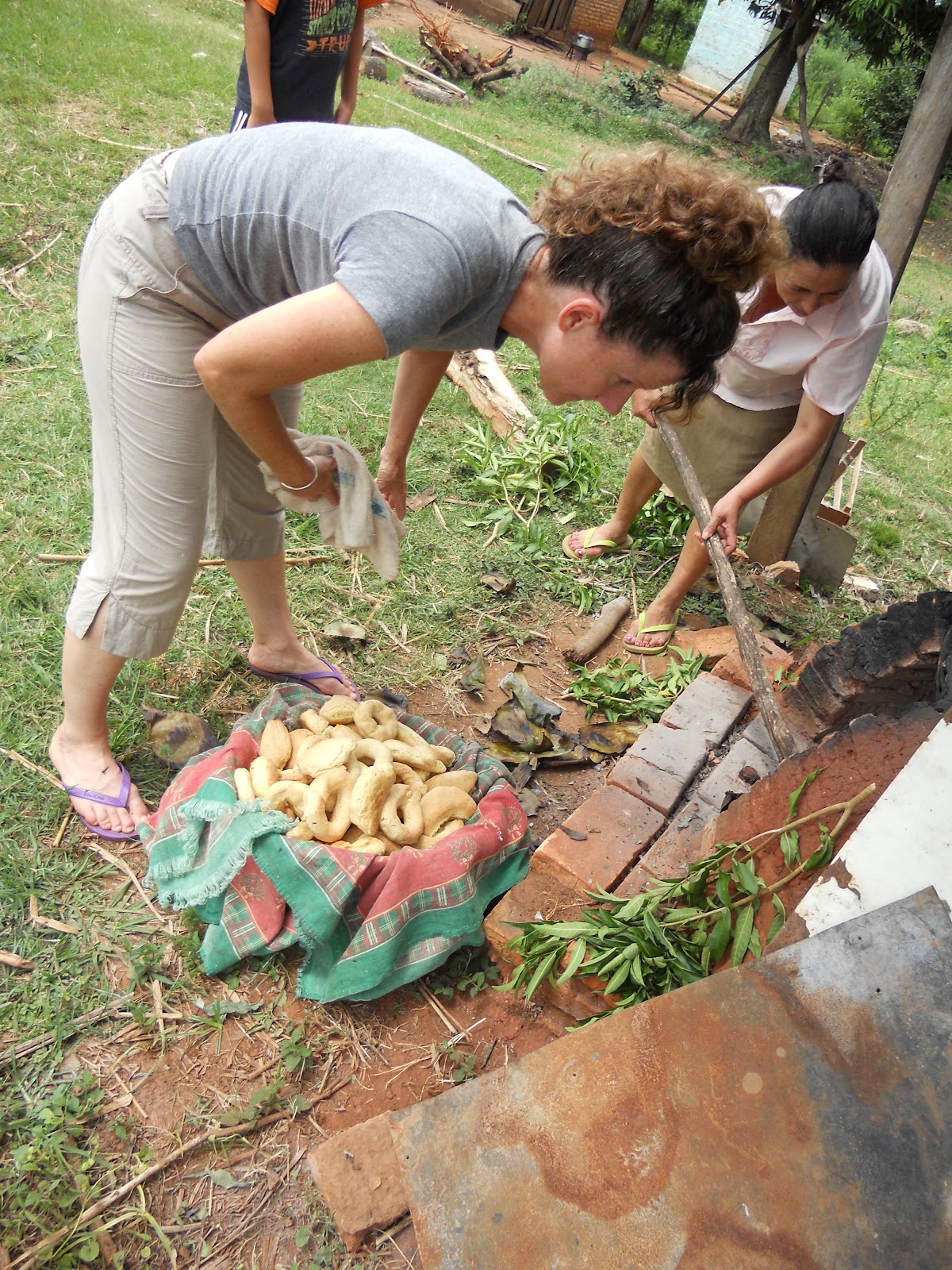
Paraguayans make a delicious bread, crunchy on the outside and chewy on the inside, called “chipa.” You can purchase chipa just about anywhere in Paraguay: on the streets; in the terminal; while on the colectivo; or from a woman carrying a large basket expertly balanced on her head.
I had the opportunity to make chipa with an expert. Being a fan of the traditional treat, I jumped at the chance. Although you may lack a tatakua’a, get your recipe card out and get ready to bake up a big batch of chipa!

1.Fill the tatakua’a with wood and start a fire, then continue to feed the fire so the bricks get hot throughout.


2. Heat ¼ pot of pig fat until it liquefies, cool; add equal parts of mandioca flour and corn flour; a big hunk of cheese; add a few cups of whey, (left over from the cheese making process); about 15 eggs and a small handful of anise seed. Mix well by hand.


3.Knead the dough, then form into rings or small buns and place on banana leaves.


4. After about an hour, remove any remaining wood from the tatakua’a and sweep out the ash.

5. Place the chipa in the tatakua’a and seal the oven.

6. After about 20 minutes, carefully remove the baked chipa. Ten cuidado- it’s HOT!

7. Enjoy!


Tuesday, December 27, 2011

Celebrating Christmas- Paraguayan Style


Feliz Navidad!

Welcoming a couple of Nortes into their home for a Christmas celebration was a first observation of the hospitality and amistad of the Paraguayan people. It was interesting to observe the different ways the same holiday is celebrated, as well as the similarities. Here we go, Christmas, Paraguayan style!

The festivities began well before Christmas. Instead of a tree, a Navidad crèche is decorated outside of the family home. Our host brother and sister did a fine job!


As in the states, a feast is prepared. In Paraguay, a cow was killed for the celebration. Every part was used, from the stomach/intestines; to the head with horns, tongue, eyes in tact, (cooked whole); to the forelegs with hooves still attached; to the hide. Though some of these delicacies were not my favorites, (brain scooped from the spinal column in the back of the skull), I did appreciate the way the entire animal was used, leaving little waste behind.


The feast, which began at 11:00pm on the eve of the Navidad, also included a special fruit punch called “clarico.” A 5 gallon bucket was filled with about 20 pounds of chopped fruit, (brought in from Asuncion), bottles of red wine, champagne, and cana, (distilled sugar cane juice). It was hard to limit ourselves, fresh fruit is a rare treat here!


As 12:00 neared, the sound of "bombas" filled the air. The firecrackers, lit on a coal from the asado, were thrown with excitement by two 5 year-old boys. The countdown then began, and at midnight, hugs, kisses, and “felicidades!” were exchanged. There was talk of going to the Polidiportivo to join in the music and dancing, but we opted to stick close to home.

On the morning of the Navidad, the feasting, conversation, and time spent with family continued on into the evening. Gifts did not seem to be an important part of this holiday, as they are in the states- the people seemed just as happy, though.

Being so far from home and away from family and friends during the holidays was not easy for us. But, if we had to choose another place and family to be with, we were exactly where we’d choose to be. 

Feliz Navidad, Merry Christmas, and Happy New Year!!!


Sunday, December 18, 2011

Just Where You Are- That's The Place To Start. -Pema Chodron

We have arrived in Arazape! 


We have settled in and are living with a wonderful family who have graciously invited us to spend the holidays with them. They have 11 grown children, grandkids, and lots of extended family members, so it should be a good-sized crowd! A cow has been "selected" for the feast. At the last family gathering we ate carpincho, (capybara), an endangered species? Argh!
We have located a house that we hope to rent, (in about 5 weeks), complete with inside bathroom and kitchen. Chuchi! The rent is 300,000 guaranis, (about $70 US dollars per month).                   
We have begun our work as Peace Corps volunteers, by starting to conduct a community needs assessment. What is this, you may be wondering? Well, we created 15 questions in Guarani and are visiting people in their homes to collect information that will guide the type of work we do during the next 2 years. Here's the challenge: first- pronounce the words in Guarani well enough, so our questions can be understood. Secondly- listen carefully, trying to decipher as much as possible, and get something written down. It's actually a pretty exhausting experience with our limited Guarani and Spanish. Fortunately, Paraguayans are very welcoming and patient, and are helping us to collect important information about the community, the strengths and needs.
I have also been brainstorming with our host sister about starting an environmental day camp for the jovenes. At this point, we're just starting to pull some ideas together.
As I am completing this journal entry, our Paraguayan family is putting the finishing touches on the Navidad creche; firecrackers, beeping motos, and Yeehas! celebrate the Olimpia victory, (Futbol), and music blares from the patio.
There you have it, our first 5 days in site as official Peace Corps volunteers.
:) Hasta luegomante.

Sunday, December 11, 2011

Dear Maxwell Third Graders,

Through  Peace Corps World Wise Schools, I am corresponding with a third grade class at awesome Maxwell Elementary! This is just a sampling of some of our first experiences here in Paraguay, complete with photos, (now that I have had a little time to figure out how to post photos- thanks for the nudge, Ash).

  Dear Maxwell Elementary Third Graders,

I hope you are all happy, having fun at recess and reading every day! I miss you all and everyone at Maxwell, so I wanted to write and let you know that I am doing well and learning lots about Paraguay and the wonderful people who live here.

Did you know that I was going to school just like you? I just finished with 2 and a half months of Guarani language class and lessons about the environment and culture in Paraguay. I worked hard, completed my homework every night, and gave my personal best, just like you do every day at Maxwell.

I am sending some pictures to show you some of my daily experiences here in Paraguay. I hope you enjoy them:
This was my first home in Paraguay!
I help cook over an open fire in the kitchen.

I wash my clothes by hand in a scrub sink

I say "Mba eichapa nekoe" (good morning) to my neighbor every morning as he heads to work in the sugar cane fields.

I plant trees with kids and learn about reforestation.


I learn technical skills with other volunteers,
then walk about 2 miles to get home, enjoying beautiful scenery!
 Two days ago, Mr. Alves and I completed our training and swore-in as official Peace Corps volunteers. We celebrated with other volunteers and Antolina, the woman we stayed with the past 10 weeks.
In two days we will move to our new Paraguayan community, Arazape, to begin our our Peace Corps service. We are very excited to get started with work and service!

Keep working hard at school and I will do the same here in Paraguay.

Love,
Mrs. Alves

Queso Paraguayo!


Queso Paraguayo!

Many Paraguayans own a cow or two  for milk production for home consumption. A well-loved milk product is the ever-popular Queso Paraguayo, (Paraguayan cheese).  I had the opportunity to learn how to make this cheesy goodness and wanted to share this cultural experience with you. So, get your recipe cards out and let’s get started!

1. First, warm the milk up to a little warmer than skin temperature. (We cook over an open fire in our kitchen. The hen in the cupboard raised a healthy brood of 12 chicks, and the duck is setting on 6 eggs in the other corner. This is also a popular hang out for the family dogs.


2. Second, find a section of cow stomach/intestine, (cleaned), and submerge it into the warm milk. Next, lift it in and out of the pot of milk about 10 times.

3. Third, remove the milk from the heat, remove the cow stomach, and stir the milk with your hands. The curds will gradually begin to form and separate from the whey.

4. Fourth, lift the curds and place in a cheese mold, pressing firmly.

5. Fifth, allow the cheese to drain and remove from the mold in about three hours.

And there you have it! Paraguayans put cheese in many dishes to add flavor, including: soups, empanadas, eggs, corn bread, and chipa. Ah, chipa- chipa deserves a blog post all to itself, so stay tuned! 

Sunday, November 6, 2011

50th in Paraguay!

Ten cuidado- this post may not be suitable for those with weak stomachs...

Yes- I shared my 50th B-day with the Peace Corps 50th Anniversary!

My 50th brought with it much time communing with nature and some interesting desicion making..... Do I have time to run to the outhouse to puke? Do I really want to go to the outhouse to puke? In the end, my body made the decision for me- around the corner, in the grass suited me fine. :)
Then, body awareness continues, even at 50. How long do you have after intense internal swishing sounds, followed by the "rush to the gate", before you need to swing that outhouse door shut? Happily, the self control I´ve developed over the years helped me to remain an outsider to the popular, "I crapped my pants" trainee club, even though the president was hoping to increase membership...
After an herbal remedy prepared by Antolina- a tea brewed with plantain root, a Clean Canteen filled with boiled water and a little rice with cheese, I was as good as new!
The icing on the cake was the visits from fellow trainees, despite my ability to unknowingly share the dreaded chivivi. :) Lots of B-day wishes, hand made cards, a b-day crown, a beautiful ao poi blusa, a b-day card from the states, (thanks Mom!), and a special card from my Maxwell buddy Kim, (Thanks!), and my entire conservation environment group sporting black in my honor. :)
Despite a rough start to the day, overall, I had a great 50th b-day in Paraguay. I just need to look at the gorgeous scenery that greets me every time I open the door to my casita- I´m living in the Heart of South America- Paraguay!

Wielding a machete, (and keeping all of your body parts intact)

Learning tecnical skills is part of the training we are all receiving in PC Paraguay. As part of a huerta, (garden), project, we built a fence made of bamboo, using machetes. Some things to consider in the fine art of machete wielding:
1. Locate your feet and legs- do not allow the machete to come in contact with them.

2. Maintain a safe distance between you non-wielding hand and the machete.

3. Sharpen your spatial awareness- good friends don´t let friends wildly swing machetes, especially near them!

Once the ground rules were set, we went to work splitting and quartering four foot long sections of bamboo. These were lashed to bamboo cross members, attached to fence posts.
Our bamboo fence turned out great and will do a fine job of protecting our garden from the chickens, ducks, dogs, and cows that live on the farm. Not to mention the awesome machete skills we learned in the process!

Cultural Discoveries!

When you come to visit Paraguay, (and I know you will), here are a few cultural adaptations you may encounter. Here are a few of my observations in the form of a top 10 list...

1. If you want to say hello, don´t say "Hola", instead say, "Adio".

2. If you want to say goodbye, don´t say "Adios", instead say, "Chao".

3. To visit someone´s house, don´t knock on the door. Instead, outside of the property, clap, clap, clap your hands until someone comes out, then exclaim, "buen dia!"

4. Get rid of the dinner bread basket, replace it with a steamimg bowl of mandioca.

5. A regular medical check up may include vaccinations for: Yellow fever, Hepetitas A and B, Rabies, Typhus, and tetnus.

6. Get rid of your germ phobias and get ready to share a bombilla and guampa, (a special cup and straw that are shared with everyone in the group), filled with delicious terere, (cold yerba mate), while enjoying conversations with visitors to your home.

7. Slow down- long pauses during conversation are the norm while sharing terere.

8. Be prepared to assume "moto formation" while walking in groups as several motos will be passing you on your trek.

9. Enjoy your fruits and veggies in the states- these are seasonal in the campo and are not available year round- like now :).

10. Be ready yell a friendly "Adio!" to every house or moto or house you pass- Paraguayans have to be some of the friendliest people in the world!

Chao!

Wednesday, October 12, 2011

Rivers are roads which move, and which carry us whither we desire to go. - Pascal

Even though it´s only been one week since we set foot on Paraguayan soil there is so much to share. What an amazing place! I´ll try to give you some highlights of our experiences so far... Here we go:

 1. Living Situation- we´re living together! Yeay! (Peace Corps originally told us we would have to live separatly for training). We live with a woman and her two sons in a little house in the campo on a dirt road. The family has been so kind and welcoming. They are very patient with our stuttering Spanish, and teach us new words in Guarani every day. We also share our house with ducks, chickens, and cows.  We do have electricity and running water- very chuchi! We have our own room with an earth floor and even a fan. Our outdoor bathroom has a flush toilet and a cold water shower. We wash our clothes with buckets of water in a cement scrub sink. We use the same bucket for washing our faces and brushing our teeth, while waving to the ox cart man every morning!
2. Surroundings- The landscape is lush and green with lots of trees and wildflowers. The main crops grown in the area are mandioca, (cassava root), and sugar cane.
3. Food- Lots of meat and mandioca. Because it is Spring here, there are not many fruits or vegetables yet. Antolina always gives us huge amounts of food- I think she´s trying to fatten us up!
4. New Learning- Cooking over an open fire in the kitchen; making cheese with milk and cow intestines; washing clothes on a scrub sink; flagging down the collectivo, (bus); identifying herbs in the area used as natural remedies; and working hard to learn Guarani, the indiginous language of Paraguay.
5. Training sessions- We have about four hours of language class in Guarani 6 days a week with homework every night. The other half of the day is spent learning about self-care in remote locations and getting shots- Rabies and Yellow Fever). We´ve been learning about Paraguayan culture and how to navagate and get around in this area.The other trainees are great, most of whom are in their 20´s with one other couple older than us! :) We are all working hard together and forming some close bonds, already. Our teachers and PC staff are fantastic, too! We will complete our training in 9 more weeks , ( then will be assigned our permanent site). 
6. Awesome extras- There are fireflies ; toads as big as softballs; lots of red dirt roads; amazing electrical storms with torrential downpours; lots of warm and friendly people; and two marraige proposals for Tyler based on our family photo, (muy guapo hijo!).
  The direction in which the river carries us is a good one, we can´t wait to see what´s beyond the bend!